- English
- Español
- Português
- русский
- Français
- 日本語
- Deutsch
- tiếng Việt
- Italiano
- Nederlands
- ภาษาไทย
- Polski
- 한국어
- Svenska
- magyar
- Malay
- বাংলা ভাষার
- Dansk
- Suomi
- हिन्दी
- Pilipino
- Türkçe
- Gaeilge
- العربية
- Indonesia
- Norsk
- تمل
- český
- ελληνικά
- український
- Javanese
- فارسی
- தமிழ்
- తెలుగు
- नेपाली
- Burmese
- български
- ລາວ
- Latine
- Қазақша
- Euskal
- Azərbaycan
- Slovenský jazyk
- Македонски
- Lietuvos
- Eesti Keel
- Română
- Slovenski
- मराठी
- Srpski језик

Tolerance Control in Hydraulic Valve Manufacturing
In fluid‑power systems, custom hydraulic valves manage pressure, flow and direction for industrial equipment. Many buyers focus on material quality and surface finish, yet overlook tolerance. Even small dimensional errors can trigger internal leakage, pressure spikes and erratic movement. For precision‑machined hydraulic components, tight tolerance is not an extra feature — it is basic requirement for reliable field performance.
Why Hydraulic Valve Tolerance Control Is So Strict
Hydraulic valves work on close‑fit mating between spools, valve bores and sealing surfaces. Standard industrial valves run with clearances from 5‑15 microns; high‑end units demand even tighter limits. Any drift in size, roundness or position breaks this critical fit.
Too much clearance creates internal leakage, dropping system efficiency and slowing actuator response. Poor geometric accuracy causes sticky spools, unstable flow and fluctuating working pressure. When fitted to hydraulic manifolds, out‑of‑spec valves will compromise the whole manifold assembly. The end result is unplanned downtime and higher maintenance cost for end users.
Key Tolerance Control Points in Hydraulic Valve Production
Reliable valve manufacturing must control dimension, geometric form and assembly fit throughout production. Bore quality is most critical. Valve bores that house spools require honing and grinding. We hold bore tolerance within ±0.005 mm to maintain consistent operating clearance.
Roundness and cylindricity cannot be ignored. Parts may measure correct nominal size, yet local bore distortion will hurt spool sliding and sealing. At Difon Machining, CNC machining plus superfinishing keeps these geometric features within micron range for every custom hydraulic valve.
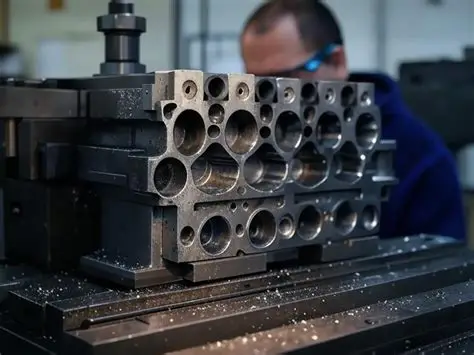
Hole and thread position tolerance also matters. Misaligned mounting holes lead to bad fit between valves and hydraulic manifolds, bringing external oil leaks and pressure drift. We use one‑setup precision machining and full dimensional inspection to avoid position errors in batch orders.
Core Advantages of Strict Tolerance Control
Tight tolerance cuts internal and external leakage, improving overall hydraulic efficiency. Pressure and flow signals become sharp and predictable. Well‑controlled precision‑machined hydraulic components also offer better interchangeability, simplifying later service and spare‑part replacement.
Good fit reduces abnormal wear on spools, seals and mating manifold blocks. Valves stay in service longer, lowering equipment downtime and operating expense for industrial customers.
Conclusion
Tolerance makes the real difference between ordinary hydraulic parts and high‑performance valve units. As a manufacturer of custom hydraulic valves and hydraulic manifolds, Difon Machining applies micron‑level tolerance standards in daily production. With precise CNC work and full‑batch inspection, we deliver stable hydraulic valves to support trouble‑free operation for global hydraulic systems.
Contact Difon Machining with your tolerance specifications to receive a free manufacturability review for your custom hydraulic valve or manifold project.