- English
- Español
- Português
- русский
- Français
- 日本語
- Deutsch
- tiếng Việt
- Italiano
- Nederlands
- ภาษาไทย
- Polski
- 한국어
- Svenska
- magyar
- Malay
- বাংলা ভাষার
- Dansk
- Suomi
- हिन्दी
- Pilipino
- Türkçe
- Gaeilge
- العربية
- Indonesia
- Norsk
- تمل
- český
- ελληνικά
- український
- Javanese
- فارسی
- தமிழ்
- తెలుగు
- नेपाली
- Burmese
- български
- ລາວ
- Latine
- Қазақша
- Euskal
- Azərbaycan
- Slovenský jazyk
- Македонски
- Lietuvos
- Eesti Keel
- Română
- Slovenski
- मराठी
- Srpski језик

Why Burr-Free Machining Is Critical in Hydraulic Systems
Hydraulic systems fail quietly. A burr breaks loose inside a valve block, enters the fluid circuit, and starts doing damage — to seals, orifices, spools — long before anything shows up on a gauge. By the time there's a symptom, the cause is long gone.
We machine hydraulic components for aerospace, automotive, oil & gas, and industrial applications. Burr control is something we've had to get right.
Where Burrs Come From
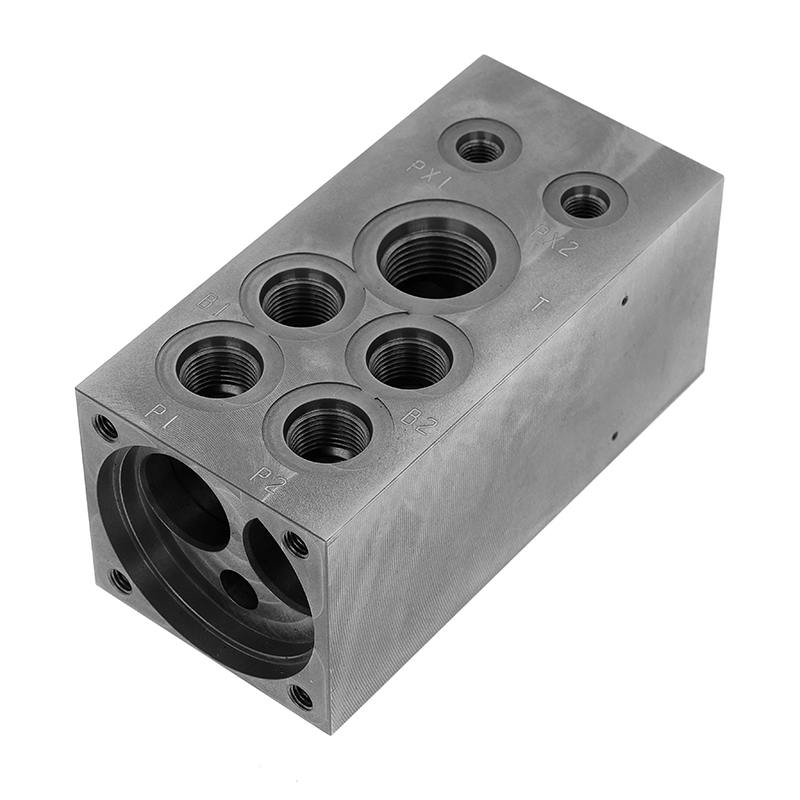
Every cross-drilled passage in a hydraulic valve block creates an intersection where a cutting tool exits through an already-machined hole. That exit point is where burrs form. A typical valve block has dozens of these — port entries, internal channels, seal groove edges, threaded connections. The same features that make the part work are the ones that make deburring hard.
Manual brushing doesn't reach them. Vibratory finishing doesn't either. Most of these burr sites are deep inside the part, out of sight and out of reach from the outside.
What Burrs Actually Do Inside a Hydraulic Circuit
Under pressure, loosely attached burrs come free and move with the fluid. They push particle counts past ISO 4406 limits, score seal lips during assembly, and partially block control orifices — changing the effective flow area in ways that shift valve behavior. That last one is particularly difficult to catch because it shows up as a tuning problem, not a contamination problem.
In brake systems, flight control actuators, and high-pressure energy sector valves, the consequences of getting this wrong go beyond a repair bill.
How We Machine to Prevent It
We don't treat deburring as a cleanup step. The goal is to not create burrs that need cleaning up in the first place — and where they do form, to address them before the part leaves the setup.
Our five-axis CNC centers let us control the approach angle at cross-drilled intersections, which directly affects burr size and adhesion at the exit point. For hydraulic valve blocks and hydraulic manifold bodies, tool path sequencing handles internal intersection cleanup within the same program — no secondary operation, no access problem.
Internal passage finishes run to Ra ≤ 0.8μm. Before anything ships, it goes through CMM inspection and helium leak testing at 1.5× working pressure.
Questions Worth Asking Before You Source
If burr control matters for your application, ask your supplier how internal intersections are deburred — and how that's verified. "We inspect for burrs" is a different answer than "we control the process so they don't form." The distinction matters in the field.
Browse our hydraulic components or reach out to our engineering team to talk through your