- English
- Español
- Português
- русский
- Français
- 日本語
- Deutsch
- tiếng Việt
- Italiano
- Nederlands
- ภาษาไทย
- Polski
- 한국어
- Svenska
- magyar
- Malay
- বাংলা ভাষার
- Dansk
- Suomi
- हिन्दी
- Pilipino
- Türkçe
- Gaeilge
- العربية
- Indonesia
- Norsk
- تمل
- český
- ελληνικά
- український
- Javanese
- فارسی
- தமிழ்
- తెలుగు
- नेपाली
- Burmese
- български
- ລາວ
- Latine
- Қазақша
- Euskal
- Azərbaycan
- Slovenský jazyk
- Македонски
- Lietuvos
- Eesti Keel
- Română
- Slovenski
- मराठी
- Srpski језик

How Does Hydraulic Manifold Machining Work?
Abstract
Hydraulic manifold machining is a critical manufacturing process used to produce compact, high-precision fluid control blocks for hydraulic systems. These components determine the efficiency, safety, and reliability of complex hydraulic circuits used in construction machinery, industrial automation, aerospace systems, and energy equipment. This article explains how hydraulic manifold machining works, key challenges, material considerations, machining techniques, quality control methods, and how professional manufacturers ensure long-term performance and leak-free operation.
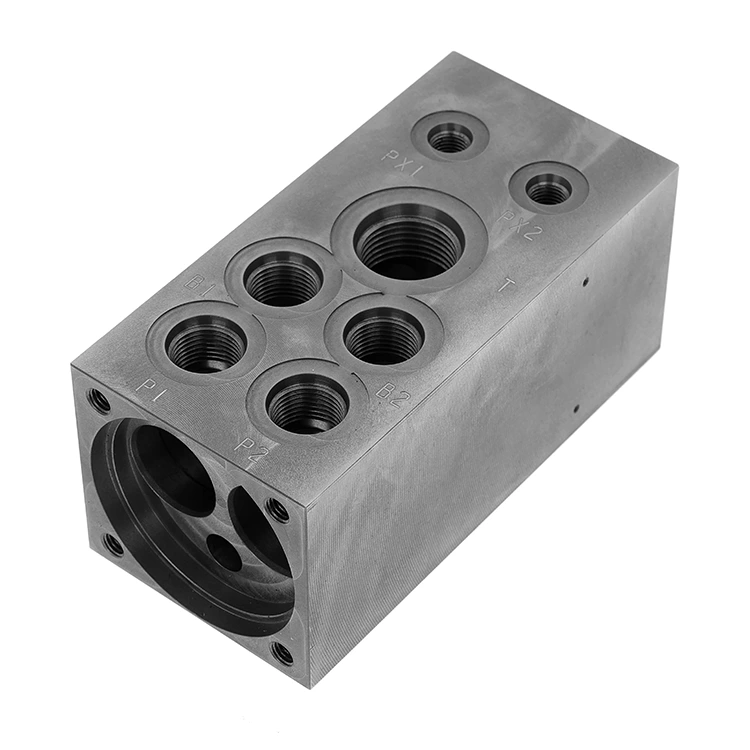
Table of Contents
- 1. Introduction to Hydraulic Manifold Machining
- 2. How the Machining Process Works
- 3. Key Manufacturing Challenges
- 4. Materials Used in Manifold Machining
- 5. Precision and Tolerance Requirements
- 6. Machining Techniques Overview
- 7. Quality Control and Testing
- 8. Industrial Applications
- 9. Professional Manufacturing Support from Difon
- 10. FAQ
1. Introduction to Hydraulic Manifold Machining
Hydraulic manifolds are engineered blocks that direct fluid flow between pumps, valves, actuators, and reservoirs in hydraulic systems. Instead of using multiple hoses and fittings, manifolds integrate channels inside a single solid block. This reduces leakage points, improves system compactness, and increases reliability.
Hydraulic manifold machining refers to the precise CNC manufacturing process that creates internal flow channels, valve ports, and sealing surfaces within a metal block. The accuracy of this process directly affects system performance and safety.
2. How the Machining Process Works
The machining of hydraulic manifolds involves several highly controlled stages. Each step requires precision engineering and advanced CNC equipment.
- Design and Engineering – Hydraulic schematics are converted into 3D CAD models defining flow paths, ports, and mounting surfaces.
- Material Preparation – High-strength aluminum, steel, or stainless steel blocks are selected and cut to size.
- CNC Programming – Tool paths are generated using CAM software to ensure accurate drilling and milling.
- Deep Hole Drilling – Internal flow channels are created using specialized drilling techniques.
- Milling and Porting – Valve cavities, threaded ports, and mounting interfaces are machined.
- Deburring and Cleaning – Internal passages are cleaned to remove chips and prevent contamination.
Each stage must be tightly controlled to ensure fluid efficiency and prevent pressure loss or leakage.
3. Key Manufacturing Challenges
Hydraulic manifold machining is highly complex due to strict functional and structural requirements.
- Internal Channel Accuracy: Even minor deviations can disrupt hydraulic flow dynamics.
- Leak Prevention: Sealing surfaces must maintain perfect flatness and finish.
- Chip Removal: Deep internal passages make cleaning difficult after machining.
- Thermal Deformation: Heat generated during machining can affect dimensional stability.
4. Materials Used in Manifold Machining
Material selection plays a vital role in performance, durability, and cost efficiency.
- Aluminum Alloys: Lightweight and corrosion-resistant, widely used in mobile hydraulic systems.
- Carbon Steel: High strength for heavy-duty industrial applications.
- Stainless Steel: Excellent corrosion resistance for harsh environments.
5. Precision and Tolerance Requirements
Hydraulic manifolds require extremely tight tolerances, often within microns. Surface roughness, perpendicularity, and concentricity directly affect hydraulic sealing and flow efficiency.
Manufacturers use advanced CNC machining centers with multi-axis control to ensure repeatability and precision consistency across production batches.
6. Machining Techniques Overview
| Technique | Purpose | Benefit |
|---|---|---|
| CNC Milling | Creates external surfaces and cavities | High precision and repeatability |
| Deep Hole Drilling | Forms internal flow channels | Enables complex fluid routing |
| Thread Tapping | Creates connection ports | Secure hydraulic fittings |
| Surface Grinding | Improves sealing surfaces | Prevents leakage |
7. Quality Control and Testing
Quality assurance is essential in hydraulic manifold production. Manufacturers implement strict inspection procedures:
- 3D coordinate measuring machine (CMM) inspection
- Pressure leakage testing
- Surface roughness analysis
- Flow path verification
Each manifold must pass pressure and sealing tests to ensure safe operation under extreme conditions.
8. Industrial Applications
Hydraulic manifolds are used in a wide range of industries where fluid power control is essential.
- Construction machinery (excavators, loaders)
- Industrial automation systems
- Aerospace hydraulic control systems
- Marine and offshore equipment
- Energy and power generation systems
9. Professional Manufacturing Support from Difon
High-quality hydraulic manifold machining requires not only advanced equipment but also deep engineering expertise. Difon specializes in precision CNC machining solutions for hydraulic systems, delivering custom manifold designs tailored to complex industrial requirements.
From prototype development to mass production, Difon ensures strict dimensional control, optimized flow design, and reliable sealing performance. Each product undergoes rigorous inspection to meet demanding operational environments.
If you are looking for stable performance, reduced leakage risk, and high-efficiency hydraulic solutions, Difon can support your project with end-to-end manufacturing capabilities. Contact us today to discuss your hydraulic manifold machining requirements.
10. FAQ
Q1: What is the main purpose of a hydraulic manifold?
A hydraulic manifold directs and controls fluid flow within a hydraulic system, replacing multiple external hoses and reducing leakage risks.
Q2: Why is machining precision so important?
Even small deviations can cause pressure loss, inefficiency, or system failure due to high-pressure fluid dynamics.
Q3: Which material is best for hydraulic manifolds?
It depends on application requirements. Aluminum is common for lightweight systems, while steel is used for high-pressure environments.
Q4: How do manufacturers ensure no leakage?
Through precision machining, surface finishing, and pressure testing under simulated working conditions.
Q5: Can Difon handle custom manifold designs?
Yes. Difon provides fully customized machining solutions based on client hydraulic system requirements.