- English
- Español
- Português
- русский
- Français
- 日本語
- Deutsch
- tiếng Việt
- Italiano
- Nederlands
- ภาษาไทย
- Polski
- 한국어
- Svenska
- magyar
- Malay
- বাংলা ভাষার
- Dansk
- Suomi
- हिन्दी
- Pilipino
- Türkçe
- Gaeilge
- العربية
- Indonesia
- Norsk
- تمل
- český
- ελληνικά
- український
- Javanese
- فارسی
- தமிழ்
- తెలుగు
- नेपाली
- Burmese
- български
- ລາວ
- Latine
- Қазақша
- Euskal
- Azərbaycan
- Slovenský jazyk
- Македонски
- Lietuvos
- Eesti Keel
- Română
- Slovenski
- मराठी
- Srpski језик
Products



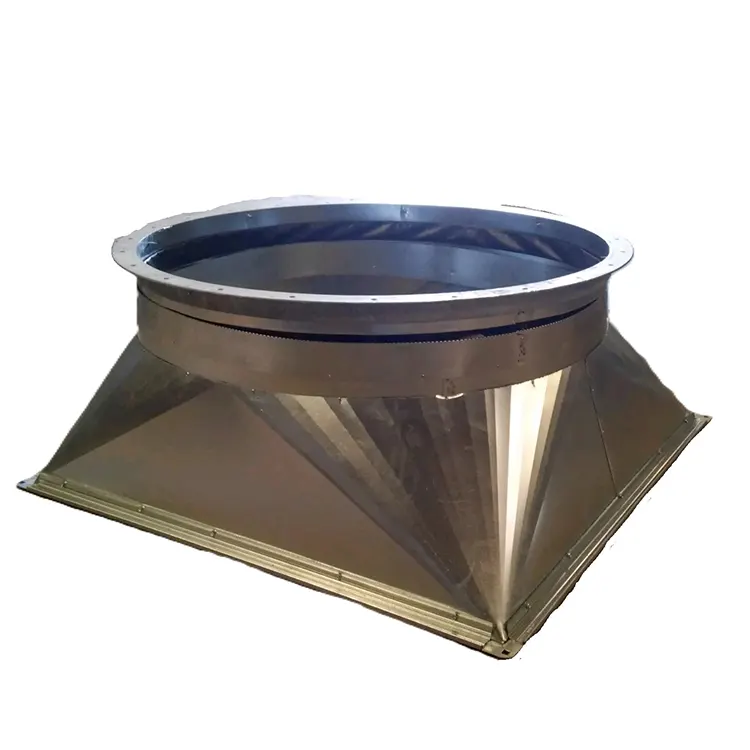
Square-To-Round Transition
Manufacturers in industries like ventilation systems, chemical fluid transfer, and environmental protection equipment often need precision square-to-round transition parts. These parts connect square or rectangular ducts/pipes to round ones, and they need to keep airflow smooth, fluid resistance low, and prevent leaks. Difon Machinery Co., Ltd.
Send Inquiry
Product Description
CNC Bending for Square-to-Round Transition Sheet Metal Parts at Difon Machinery
Manufacturers in industries like ventilation systems, chemical fluid transfer, and environmental protection equipment often need precision square-to-round transition parts. These parts connect square or rectangular ducts/pipes to round ones, and they need to keep airflow smooth, fluid resistance low, and prevent leaks. Difon Machinery Co., Ltd. is a reliable provider of CNC bending services specifically engineered for this complex sheet metal forming application. Our main offerings include custom and semi-custom square-to-round transition parts—small ones for commercial HVAC ducts, up to large ones for industrial chemical transfer pipelines. If you buy these transition parts from Difon, you skip the trouble of piecing multiple components together or using manual work. You also get a partner that knows how these parts affect your system’s overall efficiency and how long it lasts.
These square-to-round transition parts might look like simple “connectors,” but their design and making directly impact your system's efficiency, safety, and longevity. In HVAC, a poorly made transition can cause air turbulence—it uses more energy and makes more noise. In chemical fluid transfer, uneven seams or inconsistent wall thickness can lead to leaks—these are safety hazards and waste material. Many standard sheet metal suppliers lack the specialized expertise for square-to-round transitions, often resulting in compromises in precision. Difon's specialized CNC bending process is specifically designed to overcome the unique challenges of this geometry: it smoothly moves from angular (square/rectangular) to curved (round) without wrinkling the material, making it too thin, or weakening its structure. Our process is designed to deliver both engineering precision and real-world performance. Every transition part we make not only fits your square and round components perfectly but also helps your whole system work better—whether you’re moving air, water, or chemical fluids.
The production of your square-to-round transition part follows a rigorous three-phase workflow: design, production, and finishing, ensuring seamless integration into your system from start to finish. This workflow deals with the shape’s natural complexity, and it begins with detailed design optimization. Standard bending parts follow simple 2D shapes, but square-to-round transitions need precise 3D modeling. The process requires precise calculation of the “development pattern”—the flat sheet metal layout that bends into the desired transition shape. At Difon, Our engineering team utilizes advanced CAD software to make 3D models of the transition part. Then we run finite element analysis (FEA) to see how the material will act when bent. This simulation catches potential issues early. For example, if a transition from a 200mm square duct to a 150mm round pipe has a radius that’s too tight in one spot, the FEA will show material wrinkling. Our team will adjust the profile to make the transition radius a bit bigger—so the metal bends smoothly without stress. We also work with your team to make sure the design fits your system’s needs. If the transition will be in a high-temperature HVAC system, we’ll adjust the material thickness to stop warping. If it’s for corrosive chemicals, we’ll pick alloy grades that resist damage better. This design phase is foundational, not preliminary—it is critical to ensuring a smooth and successful bending process. In a recent client engagement, our FEA analysis identified and resolved a potential leak point in the initial transition design before production commenced. Once the design is done, we move to CNC-based segmented bending—this is the most important step for a smooth square-to-round transition. Simple U-bends or L-bends only need single-axis CNC machines, but square-to-round transitions need multi-axis ones. These machines can adjust pressure and angles across different parts of the sheet metal. They have programmable backgauges and real-time angle-monitoring sensors. Here’s how it works for a typical part: say a 1.5mm-thick galvanized steel transition from 250mm square to 200mm round. First, we load the flat development pattern onto the machine’s worktable. The CNC system uses the 3D design file to map 8–12 “bending segments”—each for a small part of the transition. For each segment, the machine adjusts the backgauge to position the metal exactly. Then it applies the right pressure to bend the segment to a specific angle. Between each segment, the angle sensor checks if the bend is accurate. If a segment is off by even 0.3°, the machine adjusts the pressure for the next one automatically. This segmented method avoids “material memory”—when metal resists sharp shape changes. This results in a smooth, continuous transition from square to round, free of sharp discontinuities or material deformation.
|
Material Type |
Thickness Range (mm) |
Typical Transition Size (Square→Round) |
Key Application Scenarios |
|
Galvanized Steel |
0.8–2.0 |
100mm×100mm→80mmφ – 300mm×300mm→250mmφ |
Commercial HVAC ducts, exhaust systems |
|
304 Stainless Steel |
1.0–3.0 |
200mm×200mm→150mmφ – 500mm×500mm→400mmφ |
Industrial chemical transfer, food processing pipelines |
|
5052 Aluminum |
0.5–1.5 |
80mm×80mm→60mmφ – 200mm×200mm→160mmφ |
Lightweight HVAC for data centers, automotive air intake systems |
|
Cold-Rolled Steel (SPCC) |
1.2–2.5 |
150mm×150mm→120mmφ – 400mm×400mm→320mmφ |
General industrial ventilation, dust collection systems |
To ensure the part is ready for immediate integration, it undergoes precision calibration and seam finishing.\—these steps get the square-to-round transition part ready to use in your system right away. First, we use a laser contour scanner to map the whole part’s surface. We compare this map to the original 3D design file to make sure the transition curve is consistent and the square end fits standard duct/pipe sizes. For parts that need a seam, we use TIG welding for stainless steel and aluminum or spot welding for galvanized steel. Then we grind the seam smooth to get rid of any bumps that could disrupt airflow or fluid flow. Additionally, each batch undergoes a dimensional compliance check: we connect the transition part to a standard square duct and round pipe and check for gaps with a thin feeler gauge. If any gap is over 0.1mm, we adjust the bending parameters for the next set of parts. For parts that carry fluids, we add a pressure test: we seal the part, fill it with water or air, and check for leaks at 1.2 times your system’s maximum operating pressure. This makes sure no fluid seeps through the transition seams.
A key advantage of choosing Difon is our comprehensive approach to ensuring system compatibility. A lot of clients come to us with existing square and round components. They worry a custom transition part won’t fit their old systems. TTo address this concern, we provide on-site or remote 'dimension verification' services. We either send a technician to measure your existing ducts/pipes or walk you through measuring yourself with a digital caliper. Then we adjust the transition part’s design to match any small differences in your components. For example, if your square duct has a 252mm side length, we’ll change the development pattern to fit—ensuring a precise fit. We also give installation guidance: every order comes with a simple instruction sheet. It provides clear instructions for part alignment and specifies the recommended fasteners. Our technical team is also available by phone or video call to answer installation questions—a level of support that distinguishes our service.
Regular clients can benefit from custom production scheduling and inventory management programs for square-to-round transition parts. If you’re an HVAC manufacturer making 500 units a month, we can set up a recurring order with monthly shipments. We store finished parts in our climate-controlled warehouse—humidity there won’t damage galvanized steel or aluminum. Accelerate your development cycle with our rapid prototyping service: if you’re developing a new ventilation system and need one sample transition part to test airflow, we can make it in 3–5 business days with our small-batch CNC line. This lets you check performance before ordering a lot. Our system maintains detailed records of your order history. If you need to reorder a part you bought six months ago, we already have the design file and material specs. This cuts lead time by about 30% compared to new orders.
Square-to-round transition parts are more than just connectors; they are critical to system performance. They are critical components for ensuring the smooth, safe, and reliable operation of your system. By combining specialized CNC bending, design optimization, material expertise, and a commitment to compatibility, we ensure that every transition part meets your dimensional and performance requirements. Whether you’re building a commercial HVAC network, an industrial chemical pipeline, or a dust collection system, our square-to-round transition parts bridge the gap between square and round components seamlessly. Want to talk about your specific needs? Ask for a sample part? Come see our facility? Contact our team. You can watch firsthand how we turn flat sheet metal into precision parts that ensure the efficiency and reliability of your operations.
Hot Tags: Square-To-Round Transition
Related Category
Send Inquiry
Please feel free to give your inquiry in the form below. We will reply you in 24 hours.